In search of Parrotfinch
- February 2026
Preparations
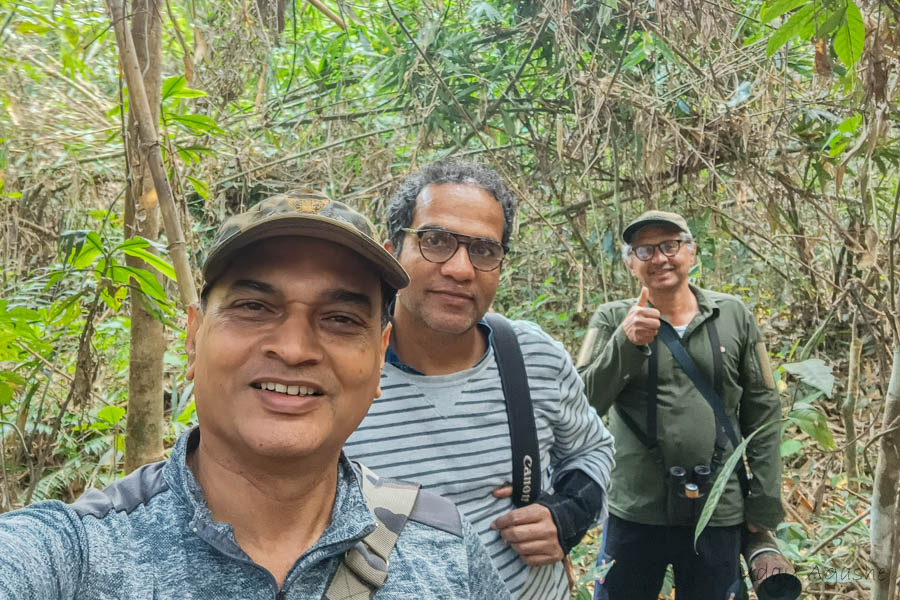
In September–October 2025, Deepak asked if I would like to join him and Santosh for a birding trip to Maguri Beel in Assam, along with a few nearby locations. The dates of local expert Binanda Hatibarouah had already been secured for 29th January to 8th February. At that stage, we had no specific target species in mind — and I had certainly not heard of a bird called the Pin-tailed Parrotfinch.
The detailed itinerary was to be finalised closer to departure. We began discussing possible locations we could cover during those ten days. Maguri Beel in Upper Assam was the obvious starting point. The nearest airport is Dibrugarh, about a two-hour drive away, and the region offers a mix of wetlands, grasslands and access to Dibru–Saikhowa National Park.
Dihing Patkai, near the oil town of Digboi, was another strong candidate — barely an hour from Maguri. As the planning progressed, we realised that we could also include Namdapha National Park and Udayak Pass in Arunachal Pradesh. All three of us had visited these areas earlier, but like most Northeast trips, a few species had been missed. January–February seemed a good window to try again.
By December, we booked our flight tickets to and from Dibrugarh, even though the finer details were still evolving.
About a week before departure, during final discussions with Binanda, the Pin-tailed Parrotfinch entered the conversation. He had seen the species in Namdapha a few weeks earlier and had already guided a few birders to it. According to him, the chances of locating the bird were fairly high.
The only complication was additional travel — although Namdapha was already part of our broader plan.
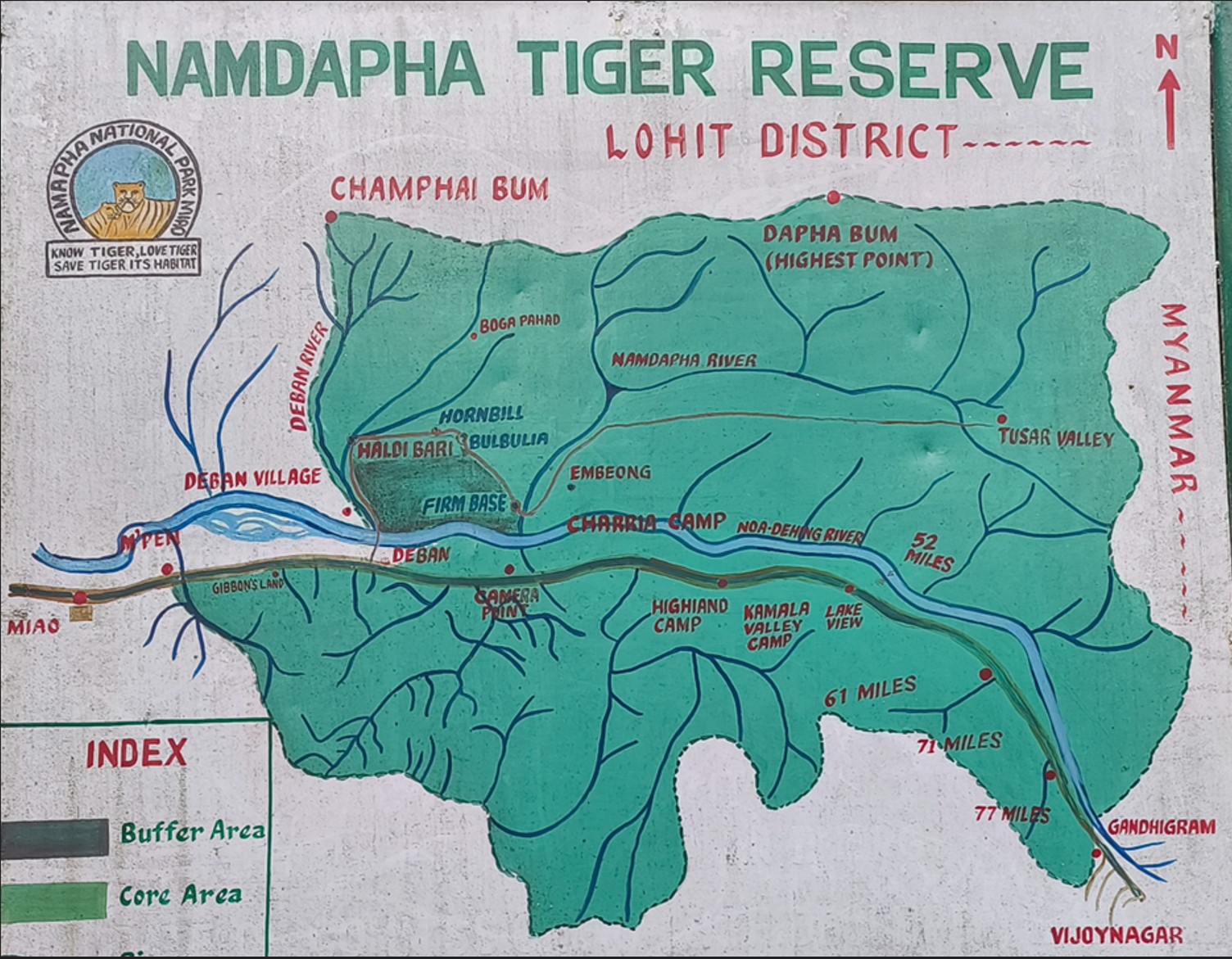
Typically, when we visit Namdapha, we stay at Deban Camp, about two hours from Miao. However, the Parrotfinches were being seen near Gandhigram, close to the far end of the forest and not far from the Myanmar border. The distance from Deban to Gandhigram is roughly 120 km.
On paper, 120 km does not sound significant — perhaps a three-hour drive under normal conditions. In reality, this stretch can take close to eight hours.
A photograph of one of the better sections of the road explains why.
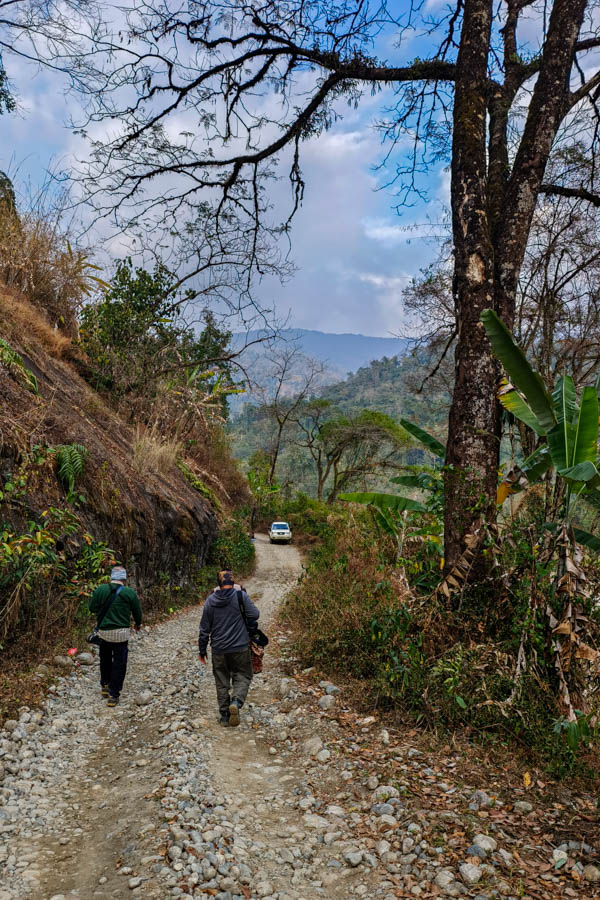
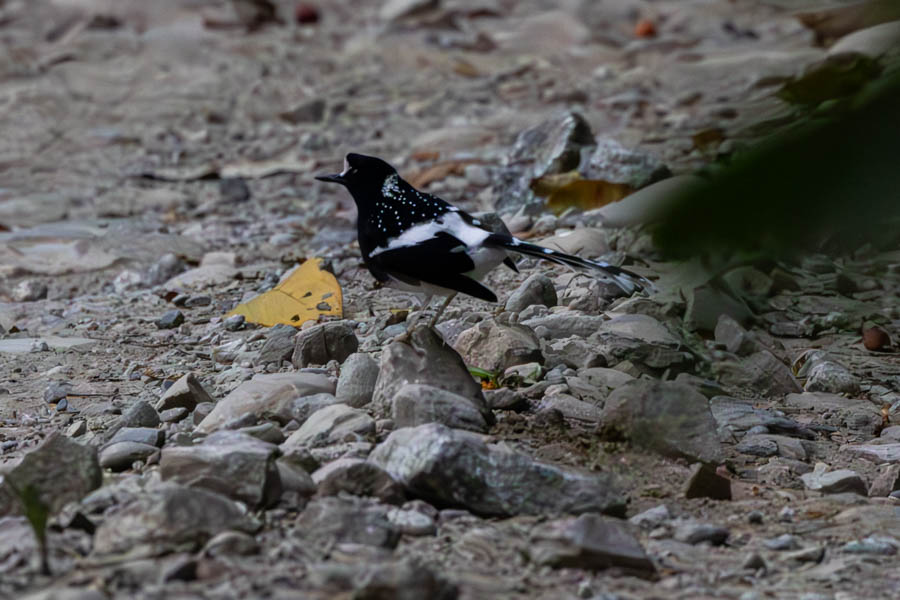
Good patches like this were rare. Much of the route involved broken surfaces where holding on to the seat was necessary. In several muddy stretches, tyre grip was unreliable. A four-wheel-drive vehicle was not optional; it was essential.
Keeping this in mind, Binanda arranged a Tata Yodha pickup truck. Over the next two days, that decision proved crucial.
Travel to Miao
We had a midnight flight on the 29th, which meant very little sleep. By morning, we landed in Dibrugarh and drove straight towards Maguri, where we would stay later during the return leg of the trip.
Before heading onward to Miao, we checked a few wetland locations for two target species, Falcated Duck (a lifer for Santosh) and Baikal Teal (a lifer for all three of us).
The Falcated Duck was located without much difficulty, but it remained distant. Thick mats of water hyacinth prevented any possibility of approaching by boat. The Baikal Teal, however, was not seen. Even the usually reliable Eastern Spot-billed Ducks were missing that day.
After a late lunch, we briefly considered a boat ride, but recent sighting reports were not encouraging. Since our luggage was already in the vehicle from the airport, we decided to proceed directly to Miao — about a three-hour drive.
By around 6 pm, we reached Dapha Lodge in Miao.
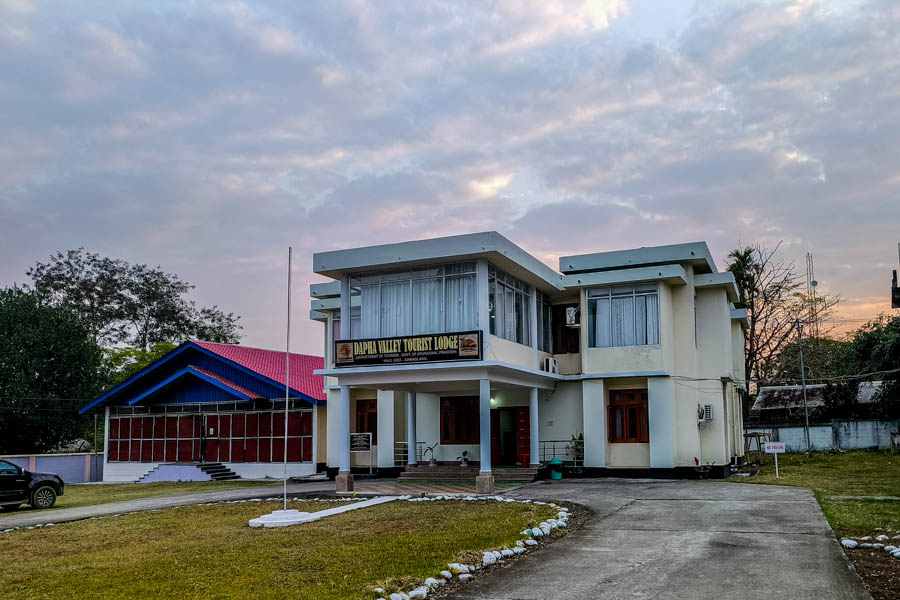
Although we had reached our night halt, Binanda still had several preparations to complete for the following day.
The original plan was to start at 5 am from Miao and drive straight towards Gandhigram, where we intended to halt for the night. Since the road conditions meant the journey would take almost the entire day, the plan was to reach by evening, stay overnight near Gandhigram, and begin early the next morning for Deban Camp, checking the Parrotfinch location on the way back.
Initially, we had planned to stay in Gandhigram village itself. However, just a couple of days before our arrival, Binanda received news that a marriage function was scheduled in the village. The homestay owner we had contacted would not be able to spare rooms for us. In such a remote location, finding alternative accommodation at short notice is practically impossible.
This meant we had to rethink not only the night stay but also dinner and breakfast arrangements. Anticipating such uncertainties, Binanda had come prepared. He carried sleeping bags and basic tent material. Along with arranging the 4-wheel-drive pickup truck, he ensured that we carried adequate food supplies like vegetables, rice, and other essentials. He had even arranged for a cook and a helper to accompany us for two days.
At dinner that evening, another update followed, this one less welcome.
Our forest permits were still not ready. Entry into Namdapha requires official permits, and movement through the gates is strictly allowed only between 5 am and 5 pm. Without the permit in hand, we could not begin our journey at 5 am as planned.
Binanda had already spoken with the forest officials, but the permit would not be available before 7 am. There was little we could do about it. The revised plan was to leave by 6 am, spend some time birding locally, and begin the longer drive once the permit was issued.
The Journey
We were ready by 6 am (after hot tea and biscuits at 5:30), but our pickup truck had not yet arrived. The team was still arranging supplies and coordinating with the helpers. The vehicle finally reached at around 6:40, and since we had some time before departure, we went on a short birding trail nearby.
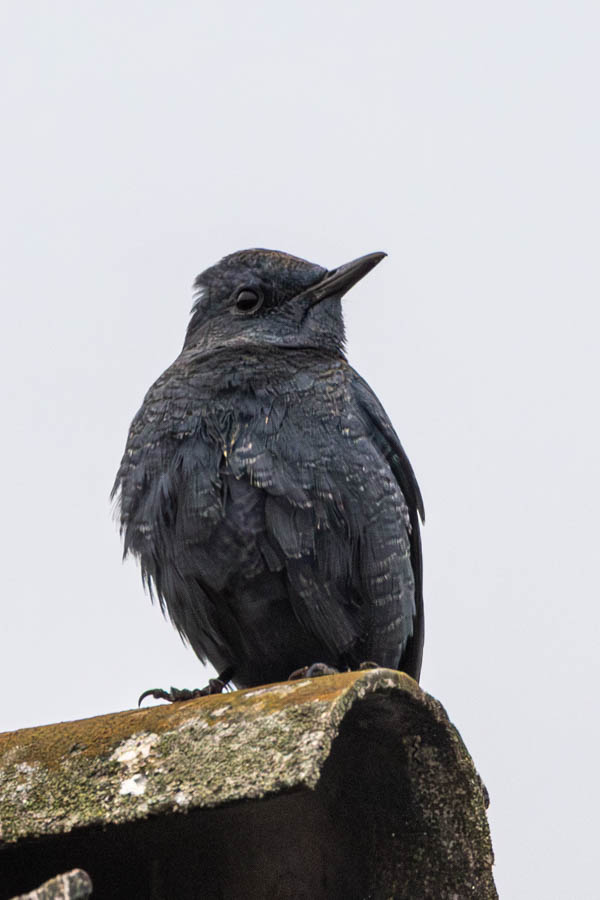
We did see a pair of White-tailed Flycatchers, though we couldn’t manage any useful photographs. Apart from a Blue Rock Thrush, there wasn’t much activity. By 8 a.m., we were back at the lodge, and the permit had also come through. At the last moment, we decided to have breakfast there itself before beginning the long drive.
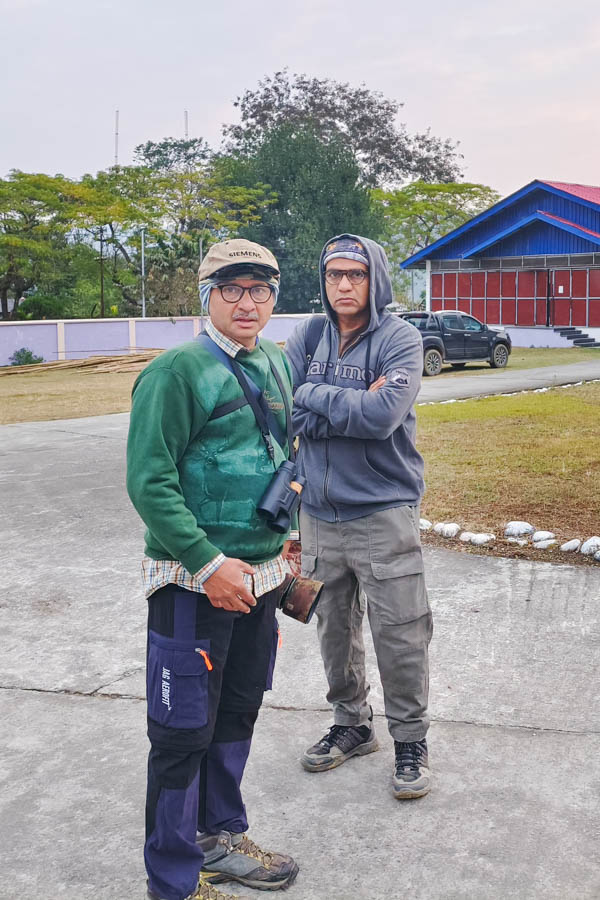
By 8:45 am, we finally started the journey. We had the front seats, while our helpers sat at the back of the pickup along with luggage and food supplies. Their job was not only to travel with us but also to ensure that nothing fell off the vehicle during the bumpy ride.
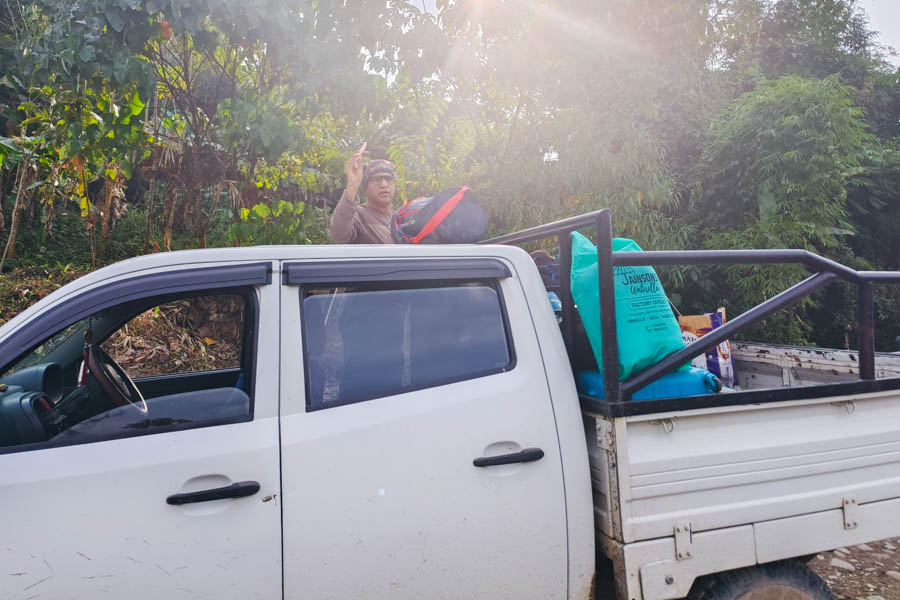
From then until about 3 pm, it was mostly a test of endurance. Since we had started later than planned, we could not afford any en route birding stops. Binanda was concerned that reaching too late would make it difficult to arrange night accommodation. In such remote areas, it is always easier to speak with local villagers during daylight.
Except for brief bio-breaks, our only proper halt was for lunch. We were carrying boiled eggs, rice, dal and some salad, packed by the lodge kitchen. It was nearly 2 pm by then, and we still had about 20–25 km to cover, though the exact distance depended on where we eventually found a place to stay.
On the way, we stopped at a couple of spots to scan for White-bellied Heron. Through small openings along the valley side, we could see the river flowing below. We checked carefully but there were no signs of the bird.
Around 3:30 pm, we passed a small hamlet where our driver Kunal knew a few people. He got down and knocked on one house to enquire about a possible night stay. The elders were out in the fields; only a young girl (around ten years old) and her brother were at home. They probably assumed we were customers for their small roadside stall just outside the house.
Kunal managed to speak with the parents over a walkie-talkie. Their house was too small to accommodate all of us, but they suggested another place a little ahead. We resumed our journey.
Soon after, we passed the bamboo patch where the Pin-tailed Parrotfinches had been sighted. The bamboo was in flower, exactly the kind of condition that attracts them, as they feed heavily on the seeds and flowers. However, there were no birds visible at that time. Binanda reassured us that the parrotfinches are usually active in the morning hours, so there was no immediate cause for concern.
As we were about to get back on the road, Binanda noticed some movement in the vegetation. It turned out to be a small group of Rufous-headed Parrotbills, a lifer for me. We waited for a few minutes, managed some photographs, and then resumed our drive.
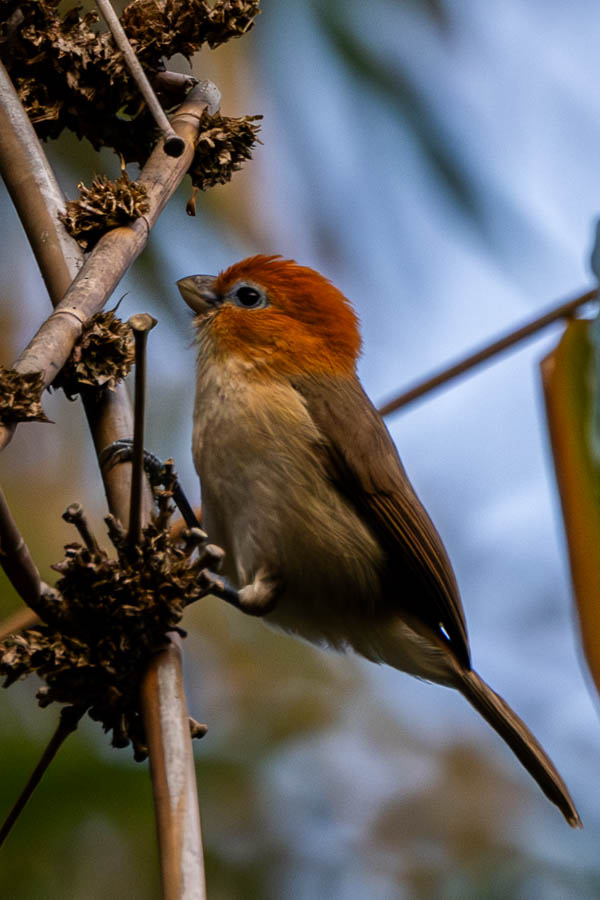
As mentioned earlier, our driver Kunal was somewhat familiar with this stretch. He had previously dropped a few forest officials at a house further ahead and hoped that we might be able to arrange accommodation there.
We reached the location around 4:30 pm. Only Kunal and Binanda stepped out initially. They spoke with the elderly couple who owned the house and, after some discussion, managed to secure their spare room for the night. Only once the arrangement was confirmed did the rest of us get down from the vehicle.
Our night halt was finally sorted.
It was a simple wooden house with a separate room where we could sleep. There was no electricity — only a couple of solar lamps for limited lighting. The toilet was outside in the compound, so any midnight visit required a short walk in complete darkness.
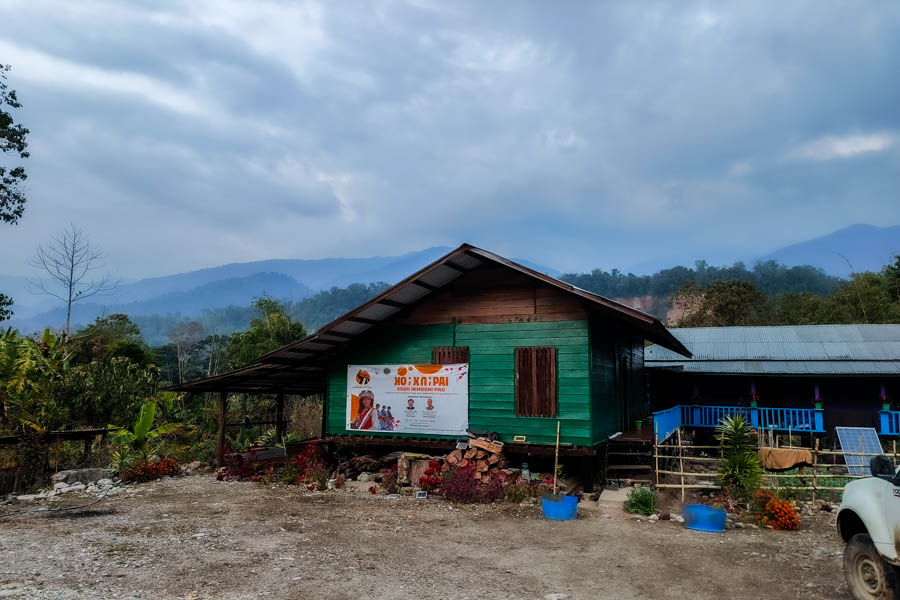
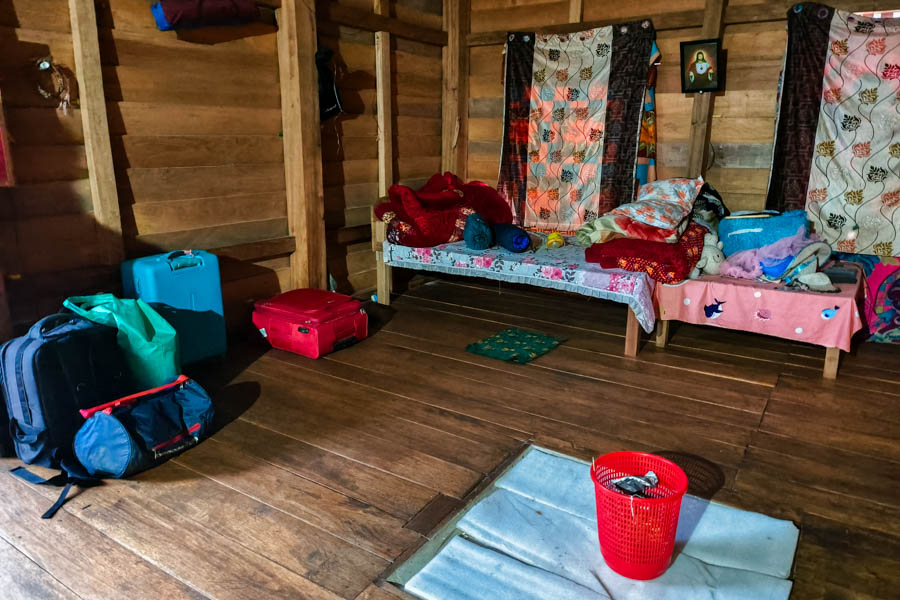
Once settled, we were pleasantly surprised to be served hot tea with biscuits, and not just black tea, but tea with milk. Considering how remote the area was, this was possible only because Binanda had carried fresh milk with our supplies. A small but thoughtful detail.
After tea, we explored the immediate surroundings and discovered that beneath the wooden flooring of the house was a small space used as the kitchen.
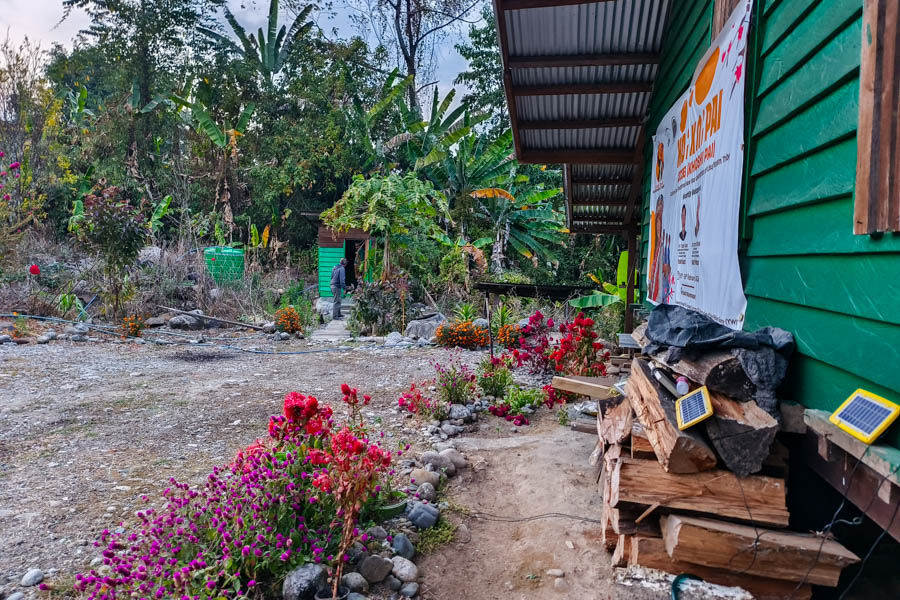
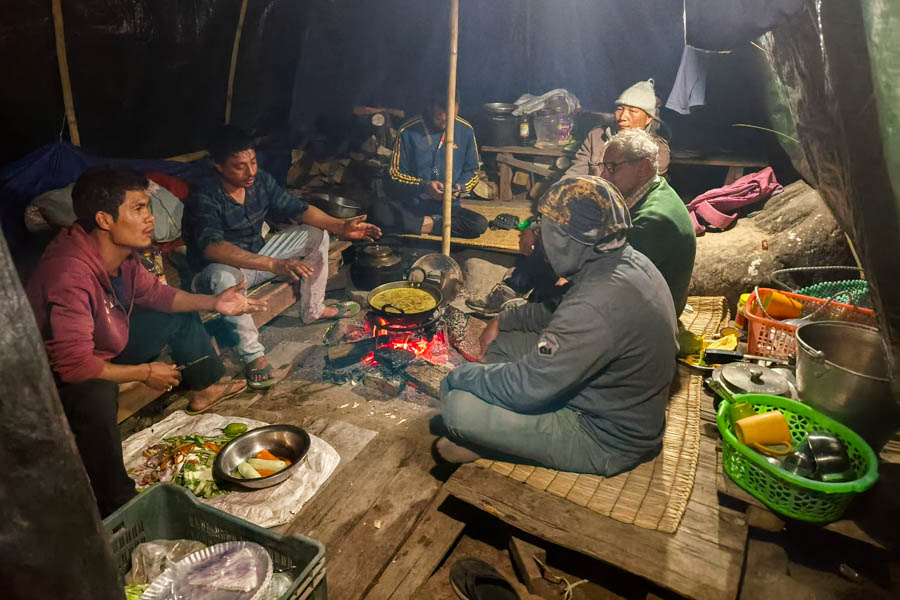
The evening was extremely quiet, almost complete stillness all around. After dinner, we took a short walk nearby before turning in for the night.
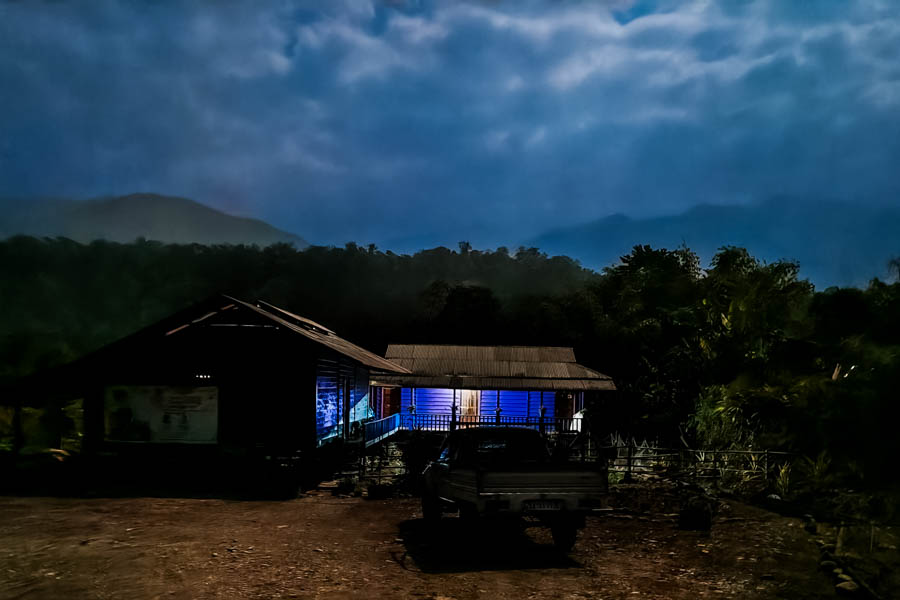
Return Journey
At exactly 5 am, we set out for the Parrotfinch trail. Our bags were packed but left behind for the moment. Kunal dropped us at the birding spot and returned to collect the luggage and helpers, which also gave them time to prepare breakfast.
We had reached early. The light was only beginning to break. Binanda began scanning the flowering bamboo through his binoculars, but initially, there was no activity. After nearly half an hour of waiting, we noticed some movement. Once again, it was the parrotbills, this time a mixed flock of Rufous-headed and Pale-billed Parrotbills.
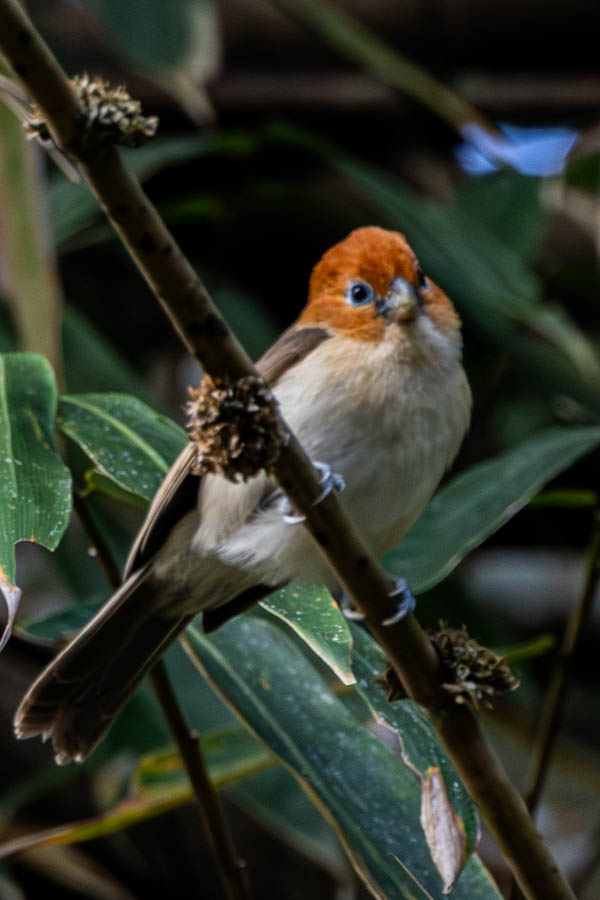
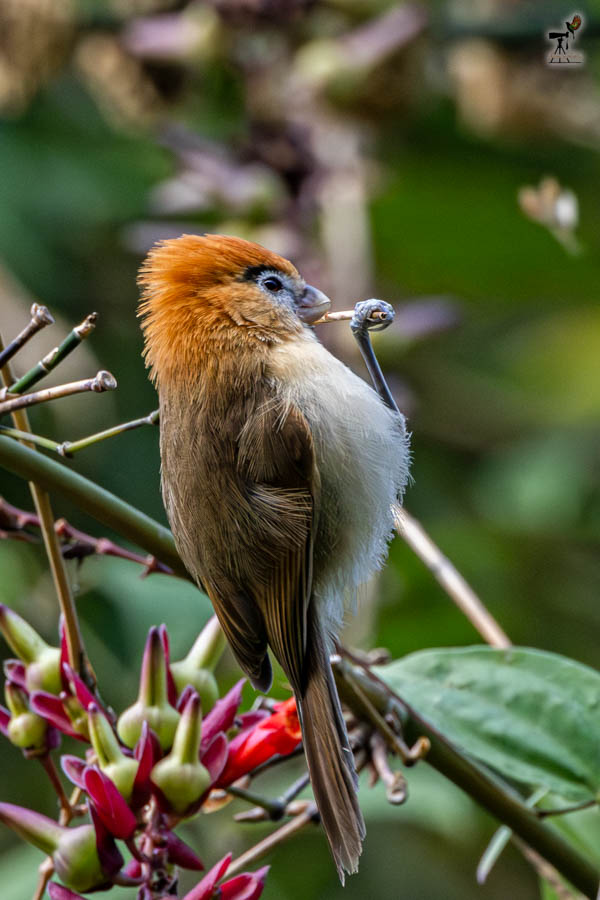
While we were busy photographing them, Binanda quietly announced that our target had arrived. Three Pin-tailed Parrotfinches were feeding on the bamboo. All appeared to be females or sub-adults. The males, which are more colourful, were not present.
We managed a few record shots and then waited, hoping the birds would move lower and closer. That did not happen. Even after another half-hour of patience, they remained high in the bamboo. Just a few days earlier, Binanda had seen a larger flock, around nine birds, including males, so we had been hopeful. That morning, however, no male appeared.
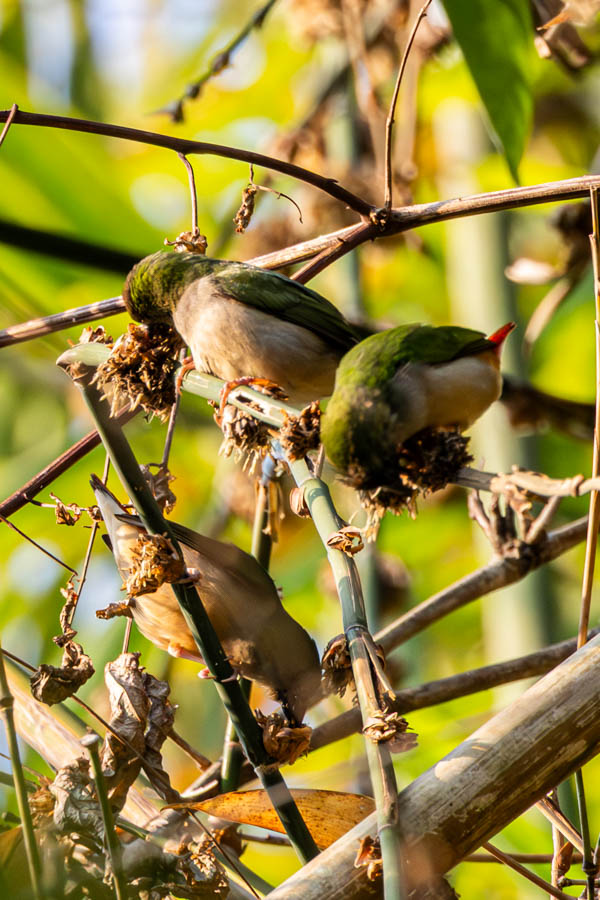
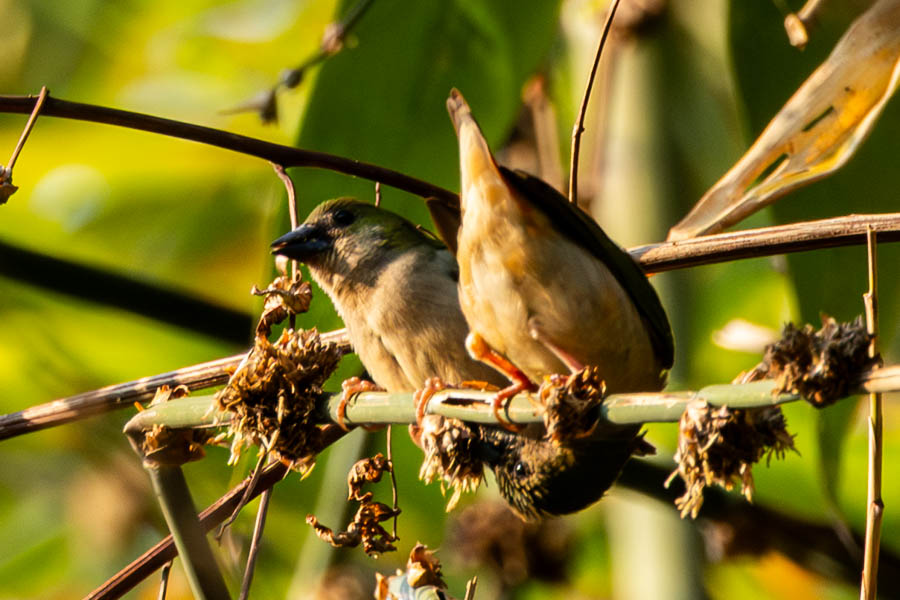
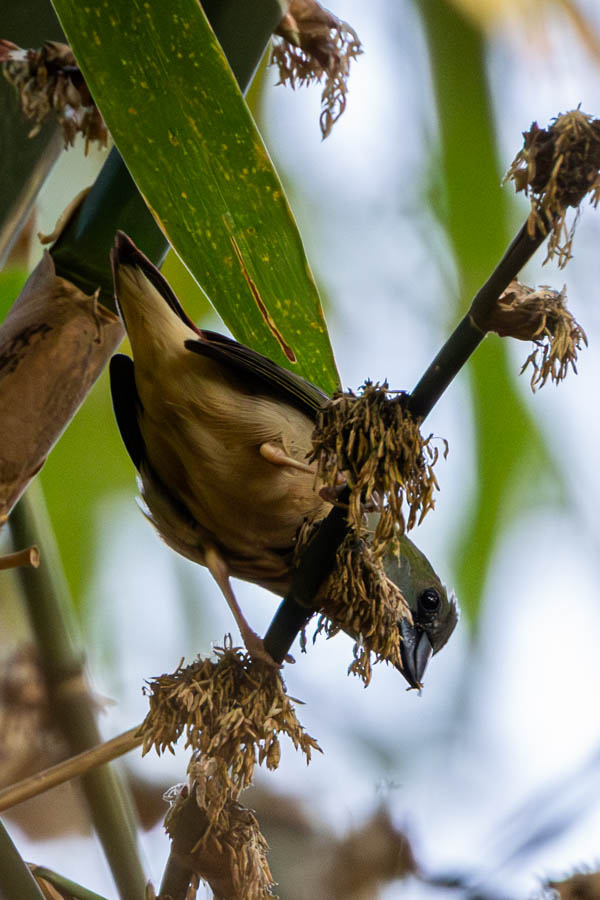
By then, our vehicle had arrived, along with breakfast. There was mild disappointment at not seeing a male and not getting better photographs, but the primary objective had been achieved, we had seen the species.
The detour to Gandhigram had meant additional travel, uncertain accommodation, and long hours on a difficult road. In the end, the effort was justified.
The Pin-tailed Parrotfinch was no longer just a name we had heard a week before the trip. It had become part of our own field notes.
What’s Next?
This Parrotfinch detour was only one chapter of our Northeast trip. A detailed account of the entire journey, including Maguri, Namdapha and Udayak Pass, will follow in a separate post.
Leave a Comment
Comments
Wow Sir, What an experience. The amount of trouble yo go through to see a single bird species is commendable and shows how passionate you are for birding. By way of your blog you have given virtual tour of Gandhigram. Loved it
Very well written Udayji. A difficult terrain, requires good health and perseverance. Would love to read the rest and reach unreachable destinations through your eyes.
Really nice write up, was enjoying reading each and every part of the writeup, even you always share pics of birds and it's detailed information which helps us to know more about birds species...
खूप छान लिहिले आहे.पक्षी निरीक्षण म्हणजे एक मोहीमच आहे .🙏
Excellent blog Uday
Nice article
Excellent blog, Binanda dada leaves no stones unturned to ensure best of the sightings... We have done many tours with him and were never let down.. Though Pintail Parrotfinch remains to be photographed, we will never leave the call of Namdhapha unheeded... GOD willing we will be there very soon....
Beautiful, detailed write-up.
वाः खूप छान वर्णन tour चे.प्रवासाच्या अत्यंत तपशीलवार नोंदी.म्हणजे आम्ही वाचताना, तुमचे सहप्रवासी होतो जणू,असा अनुभव आला.तुम्ही पक्षी निरीक्षक,गेल्या काही जन्मांत पक्षीच असणार त्याशिवाय इतकी ओढ असणं शक्यच नाही त्यांच्या भेटीची, असं मला नेहमी वाटतं.एका पक्षाला भेटण्यासाठी इतकी यातायात? अर्थात तुमच्यासाठी ती,आतुरता,लगबग कशी असते सांगू का (जशी एखादी मुलगी माहेरी जायला निघाली की तिच्या डोळ्यांमध्ये,हालचालींमध्ये, माहेरच्या माणसांना बघण्याची,भेटण्याची आतुरता असते ना) अगदी तशीच.
पक्षी आम्ही सारे...रंग आमुचे न्यारे.. असं गात गात,(हातात हात घालून?..नाही ..तुमच्या हातात कॅमेरे असतात ना..) पण तोच निरागस भाव, तीच हुरहूर असते जेव्हा तुम्ही पक्षांना भेटायला निघता..कौतुक वाटतं. Eagarly waiting for next episodes...
Awesome blog 😍
Enjoyed reading it!
Only love and passion for birding can make this difficult adventure happen for one species. Well written. I know Deepak who is equally passionate about birding !
Nehmi pramane......khupchan
Wah! All this trouble for 1 species specifically is commendable . Hats off to u
This is a different kind of passion Uday!! The effort you’ll have taken is unbelievable. Hats off to you and your friends.
Well worded. Finally efforts of your team paid off though not 100%. Appreciate the details mentioned in the blog and efforts you and the entire team takes in sharing the pics of such wonderful unheard and unseen birds. I personally appreciate each of the pic you share with us with all necessary details. Keep visiting new places and keep sharing the beautiful pics. All The Best Uday and Team.
That’s a detailed write up. Great 👍🏻 work Uday Ji 👏🏻👏🏻
Mast.. could visualise your journey.. 👌👌
Parrotbills are cutely photographed 👏🏻and so are parrot finches. Excellent work 👍
Excellent write up.Keep it up Uday Sir....All the best.
Interesting read.
Must have been a quite patient and exhaustive tour with yourself and your friends.
👒's off for your adrenaline.
Beautiful writeup sir👏
Excellent blog explaining exact efforts commitment and motivation required for sighting Male parrot finch
Nice reading. Understand the troubles you go through to get us some of the stunning photos.